
About Us
About Commercial Roofing Hoover
Commercial Roofing in Hoover, AL
Roof budgets in Hoover, AL get won or lost between January and March. Commercial Roofing Hoover is a commercial roofing contractor, and the calendar is how we run it. We repair, recover, replace, coat, inspect and maintain low-slope and metal roofs on offices, retail centers, warehouses, schools, medical buildings and public facilities. Owners here do not need a lecture on membranes. They need three answers: what to fix this winter, what can wait a year, and what each choice costs. So a roof walk ends with a short list. The item. The price. The date. Hand that list to a board, a lender or a tenant and it settles the question without another meeting.
Emergency Leak Calls
Weather: what Hoover roofs face
Birmingham's climate is humid and subtropical: roughly 56.6 inches of precipitation a year, humidity near 70 percent on average, and about two months of 90-degree days. Heat softens seams, humidity keeps surfaces damp, and rain tests every flashing. None of that is dramatic. It is steady wear, and steady wear is a budget line.
Storms are the second cost. Dixie Alley covers the area. Two F5 tornadoes (1977 and 1998) and an April 2011 EF4 sit in that record. Spring brings the worst thunderstorms, a second round comes in November and early December, and tropical systems from the Gulf now and then push in storm-force wind. Hail adds its own bill. Central Alabama saw softball-size stones in April 2003, and the weather service counted 29 hail days that year.
The takeaway for an owner is simple. Walk the roof before the season, not after it. A repair in February is a line item. A repair in April is a rush job. A roof that is dry going into March is a roof that is still dry in June, and that is the only forecast we rely on.
Buildings: what we roof
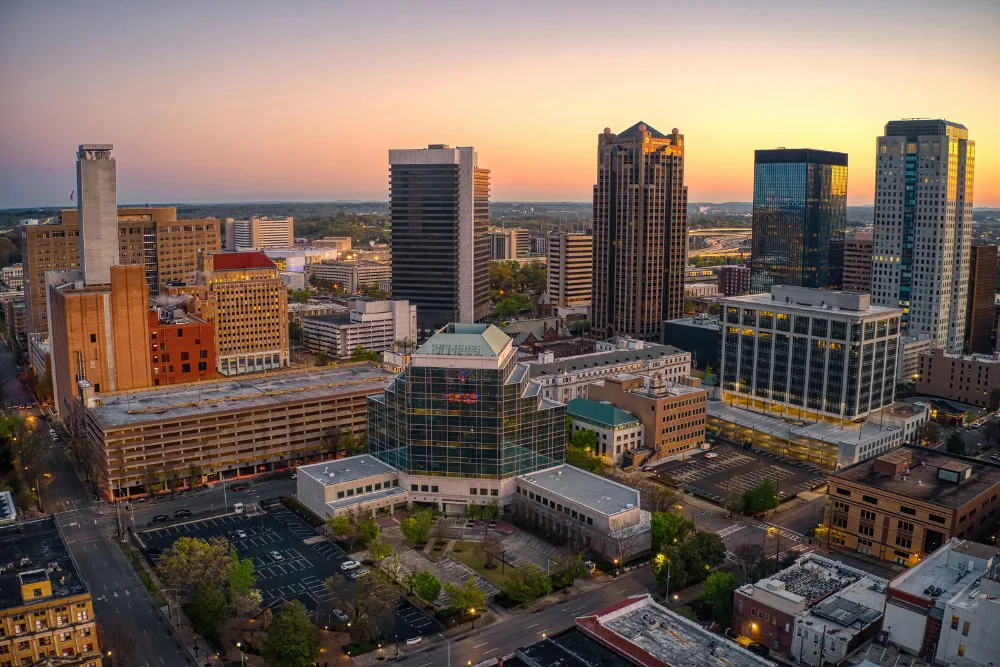
Hoover annexed the Riverchase business and residential community in 1980, bringing big office buildings inside city limits. The Riverchase Galleria, a shopping, hotel and office complex on US 31, opened in 1986. Large corporate tenants fill Riverchase Office Park and the other office parks. Riverchase sits where I-65 and I-459 intersect inside the city.
Retail runs along US 31, US 280 and SR 150. Patton Creek, a shopping area, sits on SR 150. Inverness has restaurants and shopping centers along US 280. Ross Bridge dates from 2004, so its commercial and mixed-use roofs are around twenty years old. At that age sealants and seams start to ask for attention. Beyond Hoover, Bessemer holds a large Amazon fulfillment center, and Birmingham adds hospital, bank and office roofs.
Process: how a job runs
The first step is a roof walk with a camera and a probe. We follow each leak back to where the water gets in, photograph the finding, and sort it into fix now, fix this year or watch. If the insulation under the sheet may be wet, an infrared moisture survey maps the damp areas from the surface, so nobody cuts the roof open to guess. The second step is the written summary, with a price beside each item. The third step is the work, and the size of the wet area picks the method. A repair closes one opening. A recover puts a new membrane over a dry base. A replacement removes the wet layers and starts again from the deck.
Our crews work in single-ply sheets (TPO, PVC, EPDM and KEE), modified bitumen and built-up, standing seam and retrofit metal, spray foam and coatings (silicone and acrylic), so the method follows the roof instead of the other way around. Occupied buildings stay open. Noisy stages are scheduled around tenant hours and deliveries, and tenants hear from us first. If a roof opens up overnight, a tarp or temporary seal goes on that night, any day of the week, holidays included.
Clients: who we work for
We work for the people who answer for a roof. Hoover has plenty of them. Regions Bank, Hoover City Schools, Blue Cross and Blue Shield of Alabama, AT&T of Alabama and Walmart and Sam's Club head the city's employer list, and the metro area counts 1,181,196 residents. A metro that size has rooftops owned by managers, investors, school boards, healthcare operators and retail chains, and each of them holds a different question. A property manager wants next year's budget number. A school facilities lead wants the work done before classes return. A hospital wants noise held down near patients. An adjuster wants dated photographs. We answer each in the terms that person uses. An owner with several buildings can put every roof on one schedule through a multi-site program, and a condition report fixes a starting point for every roof, so next year has something to be measured against.
Budget: how we price
Price follows four things: roof size, system, insulation condition and access. Size and system are visible on the first walk. Insulation condition needs a survey. Access depends on the building, the lot and the hours the tenants keep. We name each of those in the estimate so an owner can see why one roof costs more than the next.
We lay repair and replacement side by side. A repair costs less today and may come back. A replacement costs more today and ends the cycle. The right answer depends on how much wet insulation is in the roof and how long you plan to hold the building. We show both numbers and give a plain recommendation. If a repair will hold through the next budget year, we say so. If it will not, we say that too.
Timing is part of price. Late winter is the quiet window before storm season, with workable weather and open schedules. Spring is crowded. Hail and wind claims pile up, and crews go where the emergencies are. An owner who books in February gets a calmer schedule and a cleaner bill than one who calls in April. The same logic holds in autumn, ahead of the November storm season: repairs closed in October are cheaper than tarps laid in December.
Records: what stays with the roof
Every roof we walk ends up in a file: dated photographs, the sorted list, the price on each item, and the roof system noted by name. Next year's walk starts from that file, so the question becomes what moved, not what is there. For an owner who plans to sell or refinance, the same file answers a lender's roof question without a new survey. When a manufacturer's warranty sits on the roof, the file also holds the repair dates and materials a maker may ask to see. Alabama enforces the 2021 International Building Code, with parts of the 2024 edition added in March 2025, so a replacement scope is checked against the code in force before a price goes out.
Storm claims: paperwork that holds
After a storm, the roof is made watertight first. Then comes the file. We record damage in the order a carrier reads it, with dated photos and measurements, and we put together the claim documentation that goes with it. Storm damage and age-related wear are listed on separate lines. That keeps the claim clean and the budget straight, because the carrier decides one and the owner plans for the other. Photographs taken before cleanup starts carry the most weight, so the walk happens early.
Questions from Hoover Building Owners
What does the first visit leave me with?
A written list, not a sales pitch. Each finding has a photograph, a price and one of three labels: fix now, fix this year, watch. You can hand it to a board or a lender as it stands.
When should I schedule roof work in Hoover?
Late winter, if you can. Crews are open, weather is workable and repairs close before the March storms. Fall works too, ahead of the November storm season.
Which roof systems can you repair or replace?
Single-ply sheets, modified bitumen, built-up, standing seam and retrofit metal, spray foam, and silicone or acrylic coatings.
Do you work outside Hoover?
Yes. The work reaches across the Birmingham metro, including Pelham, Alabaster, Bessemer, Vestavia Hills, Homewood and Mountain Brook.
Does the work happen while tenants are in the building?
Most of it does. Noisy stages are scheduled around hours and deliveries, and tenants hear from us before the loud work starts.
Emergency Leak Calls
Roof Assessment
Call for a storm walk or budget review
Call and we will walk the roof. The visit pins down what to fix this winter and what can wait, and the list comes to you in writing.